
Navigating Food Anxiety & Perfectionism in College
Sometimes it can be difficult to recognize perfectionism and a silent struggle, especially when you are thriving on the outside. When you keep yourself booked from morning to night to maintain academic excellence, your struggles can remain hidden from others and even yourself. Others may assume you aren’t stressed because you consistently show up, get things done, and accomplish.
On the inside, however, you may be struggling in ways you don’t readily share. In fact, because you expect nothing short of perfection from yourself, you might not have even paused long enough to identify your own stress or anxiety.
Identifying Harms of Perfectionism
The academic and social demands of transitioning to a new college campus—and often a new city—can easily trigger feelings of anxiety or depression (Rodgers & Tennison, 2009). Life can feel chaotic and uncertain during seasons of adjustment, such as starting a new school. To cope with this uncertainty, you may find yourself trying to control various aspects of your life to manage food anxiety and adjust to your new life (Sassaroli & Ruggiero, 2010).
This drive for control can show up in unhealthy ways:
Strict Exercise Routines: Exercise can be a great way to boost mood, decrease fatigue, and help cope with stress, anxiety, and depression (Piotrowski, 2020). But what can begin as a seemingly healthy routine to structure the day can quickly become a rigid means of coping. If you find yourself spending excessive time at the gym to distract from anxiety, or if missing a workout causes you great distress, exercise may no longer be serving your well-being. Instead, it may be compulsive, which is doing something repetitively to reduce anxiety or stress through movement (Bennett, 2021; Woods & Preda, 2020).
Perfectionism with Food: For many college students with disordered eating patterns, perfectionism directly impacts their relationship with food (Sassaroli & Ruggiero, 2010). This might look like eating the exact same meal at the exact same time every day. Maybe you’re logging what you ate each day to track calories. Or perhaps you have a sense of dread, panic, or loss of control when you do not know the exact ingredients, preparation methods, or caloric content of your food.
Social Isolation and Anxiety: When a significant portion of your day is consumed by planning your next meal or workout, little room is left for spontaneity or socialization. Social anxiety frequently occurs with disordered eating patterns (Sassaroli & Ruggiero, 2010). This is often rooted in a fear of being judged while eating or being perceived negatively in public (Ayres & Bristow, 2009). You may want to socialize but find it incredibly difficult to engage in common college activities—such as eating in the dining hall, grabbing coffee between classes with a friend, or accepting a spur-of-the-moment weekend invitation because it conflicts with your strict workout or study schedule.
Strengthening Balance and Flexibility
If you recognize these patterns in yourself, there are actionable steps you can take to gain balance:
Reflect on Your Relationship with Movement: Exercise is a valuable tool for physical and mental health, but it becomes harmful when coupled with disordered eating and driven by a perceived need to control one’s body or be one of the only ways you’re coping with stressors (Mulheim, 2018).
What to do instead? Practice being honest with yourself with these reflective questions: What would it be like to take a rest day from exercise? What movement do you genuinely enjoy instead of feel you ‘have’ to do? Focus on how you feel before, during, and after exercise, and give yourself permission to rest.
Introduce Flexibility into Nutrition: While meal planning can prevent hunger during a busy class schedule full of long lectures and club meetings, hyper-scheduling every meal can lead to narrowed, anxiety-provoking thinking patterns (Mulheim, 2018; Nagel, 2019). This can take away the spontaneous joy of sharing a meal or grabbing coffee with friends.
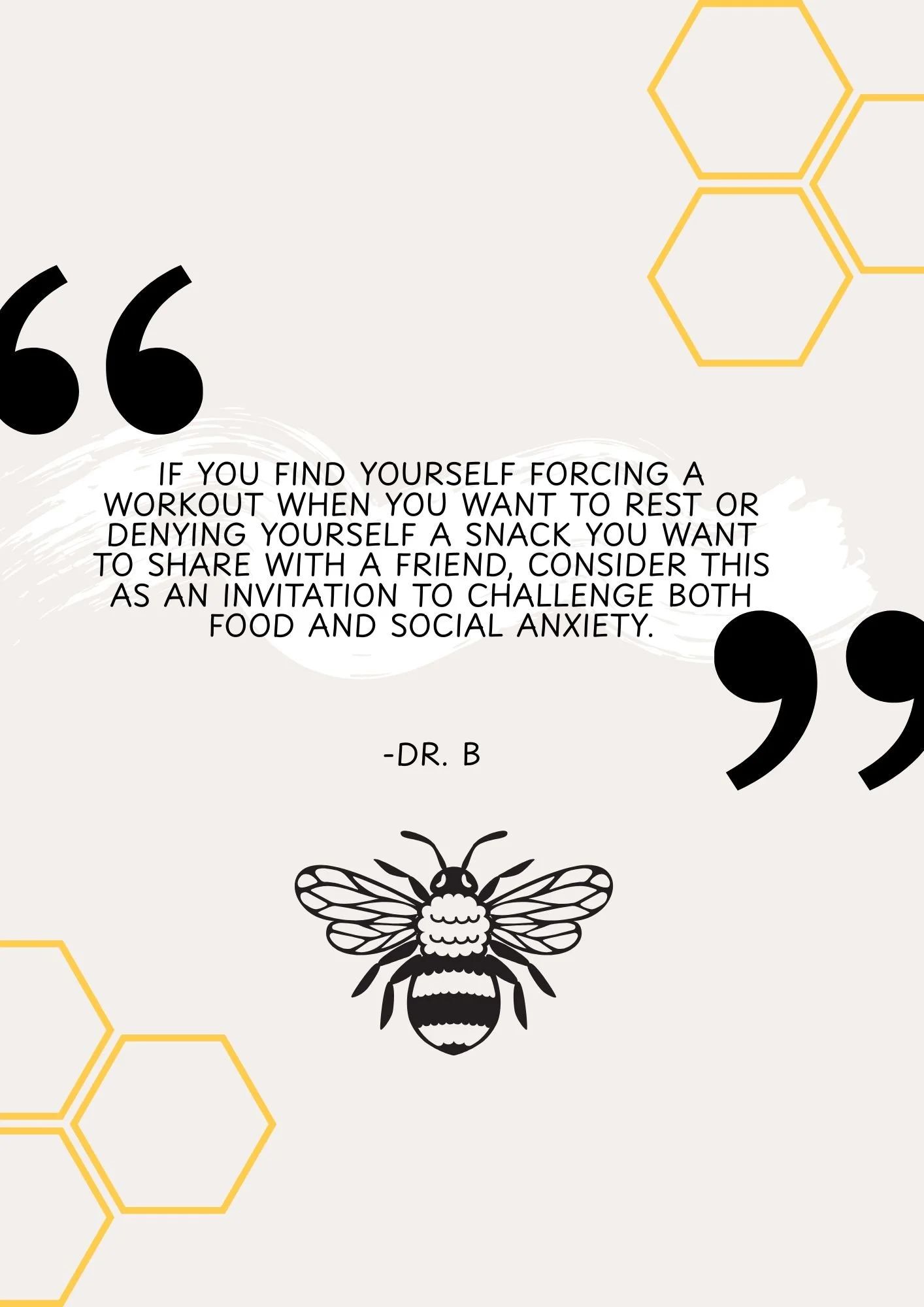
What to do instead? Try to “budget” space in your week for spontaneous social eatingReduce Avoidance: Avoidance often charades as “discipline”. In fact, others may praise you for being so “regimented” with your diet or schedule. And while avoiding might feel helpful in the short-term, it can reinforce anxiety in the long-term (Ayres & Bristow, 2009). If you find yourself forcing a workout when you want to rest or denying yourself a snack you want to share with a friend, consider this as an invitation to challenge both food and social anxiety.
What to do instead? Do you remember a recent time when you saw someone eating something that looked amazing that you didn’t let yourself eat? Examining what you’re craving can help you reduce avoidance. Notice what foods you find pleasurable and give yourself permission to eat them!
Examining Values: Academic achievement is a wonderful value, but if it is the only value driving your life, you may end up restricting other vital areas of your well-being.
What to do instead? What other values are you neglecting? How you can feed your need for social connection, hobbies, rest, and unstructured time? What could you possibly add or take from your schedule that could enhance work-life balance?
A Few Ways to Challenge Perfectionism:
Aim for "Good Enough": Challenge the need for perfection and practice self-compassion instead. Reflect on your experiences of learning rather than focusing only on your GPA or score on your last exam.
Practice Spontaneity: Think about what you’re craving- both in terms of food- and with your time. Say “yes" to unplanned moments.
Identify All-or-Nothing Thinking: Notice when your thoughts drift into extremes or absolutes (Nagel, 2019). Examples of this thinking pattern might sound something like "If I don't work out today, the week will be awful" or “I can’t go with my roommate to grab ice cream because it’s the only time that I have to study”. How might you practice flexibility instead?
Don't Do It Alone: Reach out to a trusted friend, join a campus support group, or connect with a therapist to help you navigate this transition of adjusting to college
College in California?
Have you moved away for college while still living in California? Dr. B offers virtual therapy (telehealth/video sessions offered using a HIPAA-compliant platform) to California residents
Telehealth can be a bridge for college students who are traveling for school and seek continuity of care
About the Author:
Dr. Tracy Ballardo is a licensed clinical psychologist with over a decade’s experience treating people with eating disorders in inpatient and outpatient hospitalization programs, residential treatment, community mental health settings, college and high school settings, and private practice. She assists children, teens, adults, and families with balancing school/work with other parts of their lives. Dr. B often supports people with treating anxiety, depression, and trauma that often co-occur with eating disorders. Interested in learning more? Let’s connect!
References:
Ayres, B., & Bristow, M. (Eds.). (2009). Anxiety in college students. Nova Science
Publishers, Incorporated.Bennett, K. (2021). Treating athletes with eating disorders : Bridging the gap between
sport and clinical worlds. Taylor & Francis Group.Muhlheim, L. (2018). When your teen has an eating disorder: Practical strategies to help
your teen recover from anorexia, bulimia, and binge eating. New Harbinger
Publications.Nagel, P. (2019). The mental health and wellbeing workout for teens : Skills and
exercises from ACT and CBT for
healthy thinking. Jessica Kingsley Publishers.Rodgers, L.S., & Tennison, L.R. (2009). A preliminary assessment of Adjustment
Disorder among first-year
college students. Archives of Psychiatrict Nursing, 23(3), 220-230.
https://doi.org/10.1016/j.apnu.2008.06.003Piotrowski, N. A. (2020). Exercise and Mental Health. In L. L. Wilner & M. E.
Shaal(Eds.), Principles of Health: Anxiety and Stress. Salem Press
online.salempress.com.Sassaroli, S., & Ruggiero, G. M. (Eds.). (2010). Cognitive therapy of eating disorders on
control and worry. Nova Science Publishers, Incorporated.Woods, M., & Preda, A. (2020). Conditions In-Depth: Obsessive-Compulsive Disorder
(OCD). In L.L. Wilner & M. E. Shaal (Eds.), Principles of Health: Anxiety and
Stress. Salem Press.online.salempress.com